
Few flooring environments are tested as relentlessly as schools and healthcare facilities. Constant foot traffic, rolling equipment, frequent cleaning, spills, and strict maintenance requirements mean the surface underfoot needs to perform day after day without pushing facility budgets too far.
VCT for school flooring and healthcare spaces remains a practical option because vinyl composition tile combines durability, repairability, and design flexibility with relatively economical material costs.
However, installation expenses can vary based on subfloor preparation, project size, existing flooring removal, layout complexity, and ongoing maintenance requirements. For facility managers and project planners, understanding both the upfront investment and long-term care needs is essential.
Comparing VCT installation costs, performance characteristics, design options, and maintenance expectations can help determine whether it offers the right balance of durability and value for demanding institutional spaces.
School Flooring With VCT for Education and Healthcare Spaces
Why Is VCT a Practical School Flooring Option for High-Traffic Facilities?
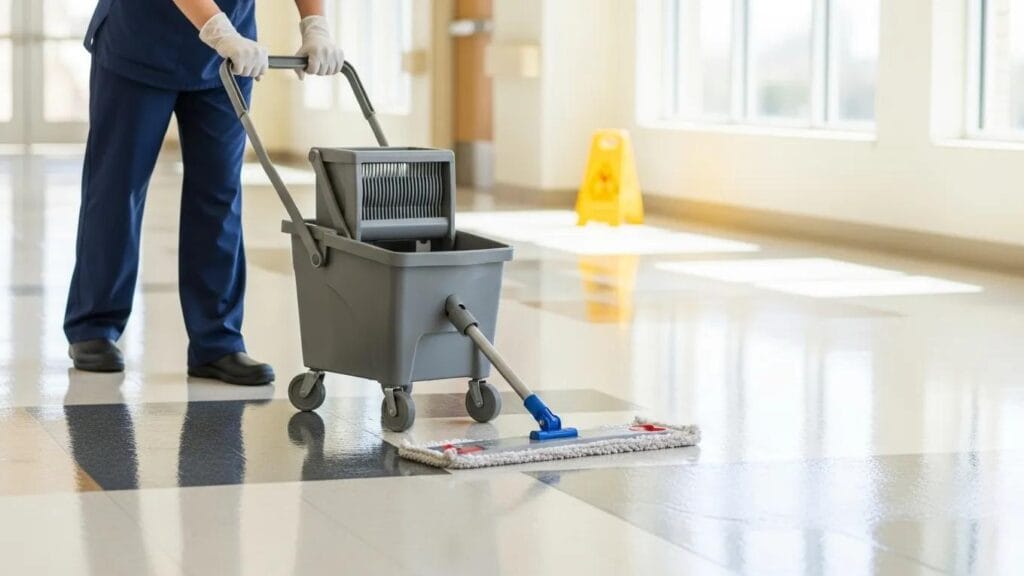
Vinyl composition tile, commonly called VCT, has long been used in schools, healthcare facilities, and other commercial buildings because it combines durability, repairability, and relatively accessible material costs.
For school flooring in particular, those qualities matter because classrooms, corridors, cafeterias, administrative areas, and common spaces experience very different types of wear throughout the day.
VCT is not maintenance-free, and it is not automatically the best choice for every room. Its value comes from how well it can perform in high-traffic spaces when the flooring system, subfloor preparation, finish program, and maintenance plan are appropriate for the facility.
VCT Handles Repetitive Foot Traffic Well
Schools and healthcare buildings put floors through constant use. In educational settings, students and staff move through hallways multiple times each day, while carts, chairs, desks, cleaning equipment, and rolling loads add another layer of wear.
Healthcare environments may involve wheelchairs, supply carts, beds, and frequent cleaning. VCT is designed for commercial use and can perform well under that repeated traffic when it is installed over a properly prepared substrate and maintained according to the flooring manufacturer’s recommendations.
One practical advantage is its tile format. If an individual tile becomes severely damaged, stained, or worn, that section can often be replaced without removing an entire room or corridor.
That repairability can be valuable in large facilities where localized damage is more common than complete floor failure.
Initial Cost Is Only Part of the Budget
VCT is often selected because the material and installation cost can be competitive compared with some other commercial flooring options. The more useful comparison, however, is total lifecycle cost.
Traditional VCT systems commonly require routine cleaning along with periodic refinishing, which may include applying new floor finish and, eventually, stripping and recoating the surface. Labor, cleaning products, equipment, downtime, and maintenance frequency all affect the long-term cost.
Facilities comparing VCT flooring installation with other resilient materials should therefore consider both the upfront project price and the maintenance program required after installation.
A lower purchase price does not necessarily mean the lowest ownership cost, particularly in buildings with large floor areas and limited maintenance staffing.
Safety Depends on the Complete Flooring System
It is more accurate to evaluate VCT for slip performance than to describe all VCT as inherently slip-resistant.
Traction can vary with the specific product, floor finish, cleaning method, contaminants, wear, and whether the surface is wet or dry. A floor that performs well under normal conditions may become more slippery when water, oils, cleaning residue, or debris are present.
For schools and healthcare environments, safety planning should include product specifications, applicable building requirements, entrance matting, spill response procedures, and appropriate maintenance practices.
Cleaning products also matter. Using incompatible chemicals or allowing residues to accumulate can change how the floor performs underfoot.
Colors and Patterns Can Support Facility Planning
VCT is available in a wide range of colors and visual patterns, which gives facilities more flexibility than simply choosing a neutral floor.
Schools can use color changes to define corridors, entrances, common areas, or circulation routes. Healthcare facilities may use flooring transitions to distinguish departments or help organize large spaces visually.
Design choices should still account for maintenance. Very light or very dark floors can make dust, scuffs, scratches, and soil more noticeable. Patterned or mid-tone designs may conceal everyday wear more effectively in heavily used spaces.
Because individual tiles can be combined into custom layouts, VCT can also support simple wayfinding or zoning strategies without requiring a completely different flooring material.
Subfloor Preparation Has a Major Effect on Performance
VCT is relatively thin, so the condition of the substrate underneath it matters. Uneven areas, cracks, contamination, excessive moisture, adhesive problems, or poorly prepared patches can eventually become visible through the finished surface or contribute to bonding failures.
Existing flooring cannot simply be covered in every situation. Whether VCT can be installed over another surface depends on the condition and type of that flooring, the substrate below it, manufacturer requirements, moisture conditions, and project specifications.
For large school flooring projects, subfloor evaluation is particularly important because small problems can become significant when repeated across thousands of square feet.
Different Rooms May Need Different Flooring
One of the most important planning decisions is recognizing that VCT does not need to be used everywhere.
It may make sense in classrooms, corridors, administrative spaces, or other high-use areas, while bathrooms, kitchens, laboratories, athletic spaces, treatment areas, or rooms with specialized moisture and sanitation requirements may call for different materials.
Healthcare facilities may also have room-specific requirements related to infection-control procedures, rolling loads, seams, chemical exposure, or specialized equipment.
Rather than choosing one product for an entire building, facility planners can evaluate flooring according to traffic, cleaning demands, moisture exposure, acoustics, safety requirements, and expected service life.
For school flooring, that room-by-room approach usually produces a more practical specification than selecting VCT solely because it is durable or affordable.
VCT remains a strong option where its strengths match the space. Its durability, replaceable tile format, broad design range, and competitive initial cost can work well in demanding facilities, but long-term value depends just as much on proper installation and realistic maintenance planning.
How Does VCT Support Safety and Hygiene in Healthcare Facilities?
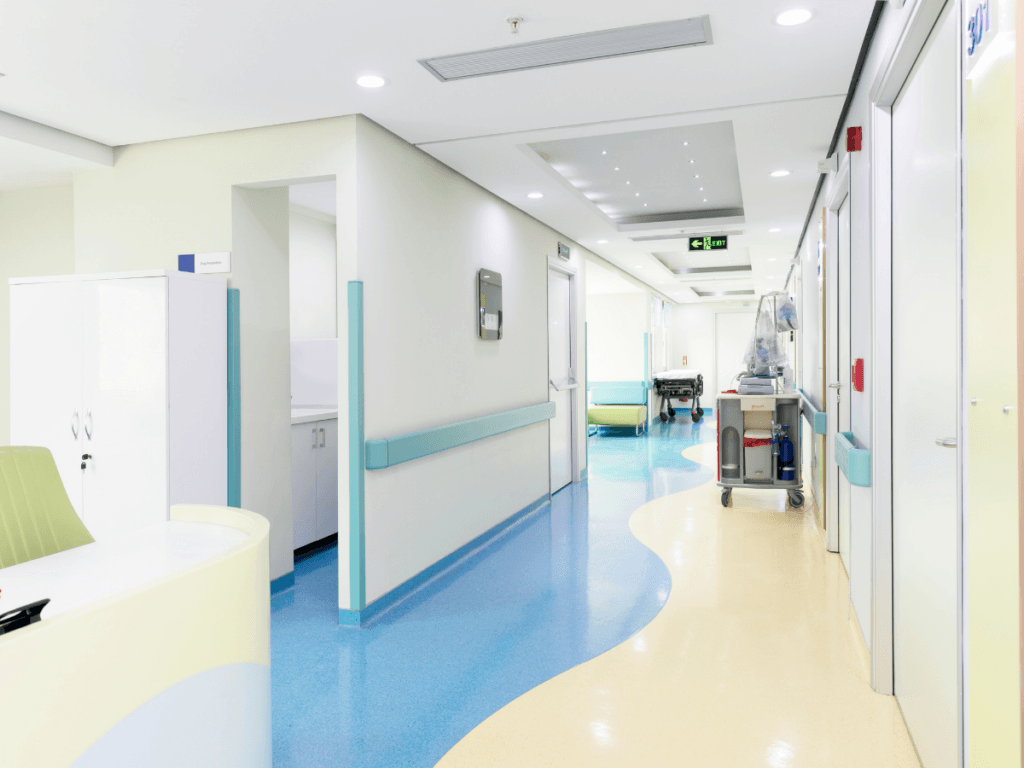
Healthcare flooring has to do more than withstand foot traffic. It must tolerate frequent cleaning, support safe movement, and remain in good condition around carts, wheelchairs, beds, staff, patients, and visitors.
Vinyl composition tile can meet many of those practical demands, which is why it is used in healthcare facilities as well as other high-traffic environments such as school flooring applications.
Its suitability, however, depends on the specific room, product specifications, maintenance program, and infection-control requirements of the facility.
VCT should not be described as inherently sterile, antibacterial, or slip-proof. Its advantage is that it provides a durable, relatively smooth surface that can be cleaned and maintained effectively when the flooring system is properly installed and cared for.
A Smooth Surface Supports Routine Environmental Cleaning
Unlike carpet and other porous floor coverings, VCT provides a hard surface that can be swept, damp-mopped, and cleaned using compatible products.
That makes routine removal of soil, spills, and other surface contaminants more manageable in areas that require frequent cleaning.
The flooring itself does not prevent infection. Infection control depends on the facility’s broader cleaning and disinfection procedures, including the products used, contact times, cleaning frequency, staff practices, and condition of the floor.
Damaged tiles, deteriorated finish, open joints, and poorly maintained edges can make cleaning more difficult, so surface condition matters just as much as material selection.
Seams and Floor Condition Matter in Healthcare Spaces
VCT is installed as individual tiles, which creates more seams than sheet vinyl.
That does not automatically make it unsuitable for healthcare use, but it does mean room-specific requirements need to be considered carefully. Areas with especially strict infection-control, fluid-management, or cleaning requirements may benefit from resilient flooring systems with fewer seams.
VCT may be more appropriate in corridors, administrative areas, waiting rooms, offices, and other spaces where its durability and repairability align with operational needs.
This is one reason flooring should be specified by space rather than applying a single material throughout an entire healthcare building.
The same principle applies to school flooring. A material that performs well in a classroom or corridor may not be the best solution for a restroom, kitchen, laboratory, athletic facility, or another area with specialized demands.
Slip Performance Depends on More Than the Tile
VCT should not be assumed to provide the same level of traction under every condition.
Slip resistance can be affected by the product, floor finish, cleaning chemicals, surface wear, dust, spills, and moisture. A normally stable floor may become hazardous if liquid is allowed to remain on the surface or if cleaning products leave a residue.
Healthcare facilities should therefore evaluate the manufacturer’s performance information along with applicable safety requirements and facility procedures.
Operational practices are equally important. Prompt spill cleanup, appropriate entrance matting, compatible cleaning products, and well-maintained floor finishes can all affect how safely the surface performs.
VCT Can Withstand Frequent Traffic and Rolling Loads
Healthcare corridors and common areas may experience constant movement from people and equipment.
VCT is designed for commercial environments and can perform well under repeated foot traffic and rolling use when the appropriate product is selected and the substrate is properly prepared.
Individual tiles can also be replaced if localized damage occurs, which may simplify some repairs compared with flooring systems that require larger sections to be removed.
Facilities evaluating VCT flooring for schools, healthcare buildings, and other high-traffic spaces should still review manufacturer requirements for rolling loads, maintenance, adhesives, and intended commercial use before specifying a product.
Cleaning Products Must Be Compatible With the Flooring
Healthcare facilities often use stronger or more frequently applied cleaning and disinfecting products than ordinary commercial buildings. Not every chemical is suitable for every flooring system.
Repeated exposure to an incompatible cleaner may affect the floor finish, appearance, traction, or adhesive system. Manufacturers typically provide guidance on approved cleaning methods and chemicals, and those recommendations should be incorporated into the facility’s maintenance plan.
It is also important to distinguish cleaning from refinishing. Traditional VCT commonly uses a protective floor finish that eventually requires restoration or replacement as it wears.
A realistic maintenance plan should account for routine cleaning as well as periodic finish maintenance.
Subfloor Moisture Can Affect Hygiene and Performance
A healthcare floor can only perform as well as the surface beneath it. Excessive moisture in a concrete slab or other substrate can contribute to adhesive failure, loose tiles, discoloration, or other flooring problems.
Once tiles begin to lift or gaps develop, the surface becomes more difficult to maintain and may create additional safety concerns.
Moisture testing and proper substrate preparation therefore belong in the flooring specification, particularly during renovations where the history of the existing slab may not be fully known.
Healthcare Flooring Should Be Selected Room by Room
VCT can be a practical option for many healthcare spaces, but describing it as the universally hygienic choice oversimplifies the decision.
The better approach is to evaluate each area according to traffic, cleaning protocols, moisture exposure, rolling equipment, slip requirements, infection-control needs, acoustics, and expected maintenance. VCT works best where its strengths match those demands.
Its durable surface, replaceable tile format, and compatibility with routine commercial cleaning can make it useful in both healthcare and school flooring projects, provided that safety and hygiene are treated as properties of the complete flooring system rather than assumptions attached to the material itself.
How Is VCT Flooring Professionally Installed in Schools and Healthcare Facilities?
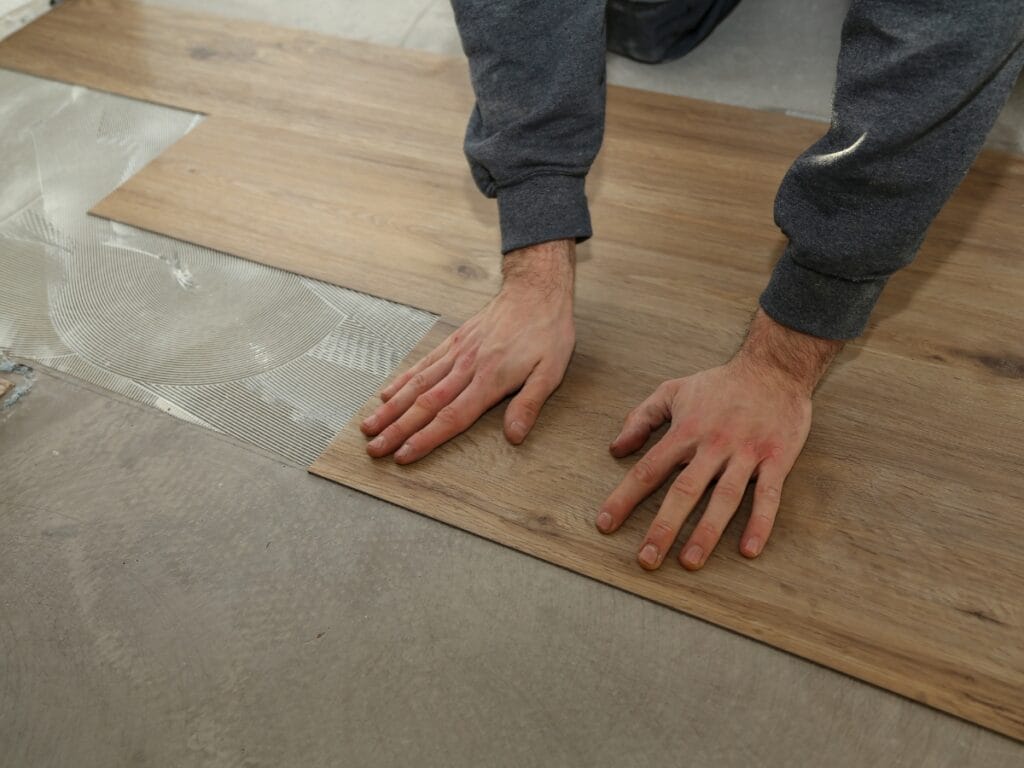
Professional VCT installation involves much more than spreading adhesive and placing tiles. In schools and healthcare facilities, the installer also has to account for substrate condition, moisture, existing flooring, traffic patterns, room access, adhesive requirements, and the amount of downtime available before the space returns to service.
Those details are especially important for school flooring projects, where installation may need to fit around classes, summer breaks, or phased renovations.
Healthcare facilities introduce their own challenges, including continuous operations, rolling equipment, cleaning protocols, and the need to keep work areas isolated from occupied spaces.
Evaluate the Existing Floor and Substrate First
The finished VCT surface depends heavily on what lies beneath it. Before installation, the substrate should be inspected for cracks, uneven areas, old adhesive, contamination, loose material, and other conditions that could interfere with bonding.
Concrete may also require moisture testing according to the flooring and adhesive manufacturers’ specifications.
Moisture problems should be addressed before new flooring is installed. Covering a problematic slab can lead to adhesive failure, discoloration, loose tiles, or other problems later.
Existing flooring also requires careful evaluation. VCT cannot automatically be installed over every old surface simply because it appears flat. The existing material, its bond to the substrate, height transitions, manufacturer requirements, and project conditions all influence whether removal or additional preparation is necessary.
Prepare a Smooth, Stable Installation Surface
VCT is relatively thin, which means irregularities beneath it can show through the finished floor. Subfloor preparation may involve removing residue, patching cracks or depressions, smoothing transitions, and correcting areas that are not sufficiently flat.
The surface must also be clean and ready to accept the specified adhesive. This stage can account for a significant portion of the work on renovation projects. It is also one of the areas where rushing the schedule can create long-term problems.
For large school flooring installations, substrate conditions may vary substantially from one wing or classroom to another, particularly in older buildings that have been renovated multiple times.
Plan the Layout Before Setting Tile
A professional layout should be established before adhesive is applied.
Installers typically determine reference lines and tile placement so that the finished pattern remains aligned across the room. Careful planning can also prevent narrow or visually awkward cuts along walls, doorways, columns, and transitions.
For schools, color and pattern changes may be used to distinguish corridors, entrances, classrooms, or common areas. Healthcare projects may require transitions between different flooring materials or departments.
Those design decisions should be resolved before installation begins rather than adjusted as tiles are being placed.
Use the Correct Adhesive and Installation Method
VCT adhesives have specific requirements for substrate preparation, application, working time, and installation conditions.
The installer should follow the flooring and adhesive manufacturers’ instructions rather than applying one universal method to every product. Temperature, humidity, substrate type, and adhesive selection can all influence how the installation proceeds.
Tiles are then positioned carefully along the established layout lines and pressed into the adhesive. The floor is typically rolled or otherwise secured according to manufacturer requirements to promote consistent contact between the tile and adhesive.
Cuts around walls, door frames, floor penetrations, and other obstacles should fit cleanly without creating oversized gaps or distorted tiles.
Protect the Floor During Adhesive Cure
Newly installed VCT should not automatically return to normal use as soon as the last tile is placed. Adhesive needs time to develop its bond, and manufacturers may restrict foot traffic, rolling loads, wet cleaning, or other activities for a specified period after installation.
This becomes an important scheduling issue in occupied facilities. Moving desks, hospital beds, carts, or heavy equipment across the floor too early can interfere with the installation. A commercial flooring schedule should therefore include curing and turnover time, not simply the hours required to lay the tile.
Complete the Required Initial Floor Care
Traditional VCT commonly relies on a floor-finish system to protect the surface and provide the desired appearance. Initial cleaning, finishing, or polishing requirements depend on the specific flooring product and manufacturer’s instructions.
That work should be coordinated with the facility’s long-term maintenance program. The products used by custodial or environmental services staff need to remain compatible with the flooring and finish.
For school flooring, discussing maintenance before installation is particularly useful because a district’s available staff, equipment, and cleaning schedule can influence whether VCT is the right material in the first place.
Plan Installation Around an Occupied Facility
Schools and healthcare buildings rarely function like empty construction sites. A successful project may require phased work, temporary closures, furniture relocation, controlled access, dust containment, and coordination with other trades.
Door clearances, transitions, base materials, accessibility requirements, and the movement of carts or mobility devices also need to be resolved before each area is returned to use.
In a school, summer or holiday installation can reduce disruption, but large projects may still need to be divided into manageable sections. Healthcare projects can be more complex because many spaces cannot simply close for several days.
Professional VCT installation is therefore as much about planning and substrate preparation as tile placement. When each stage is completed correctly, the finished floor is better positioned to withstand the demanding traffic, maintenance, and operational conditions found in schools and healthcare facilities.
How Should VCT Flooring Be Maintained in Schools and Healthcare Facilities?
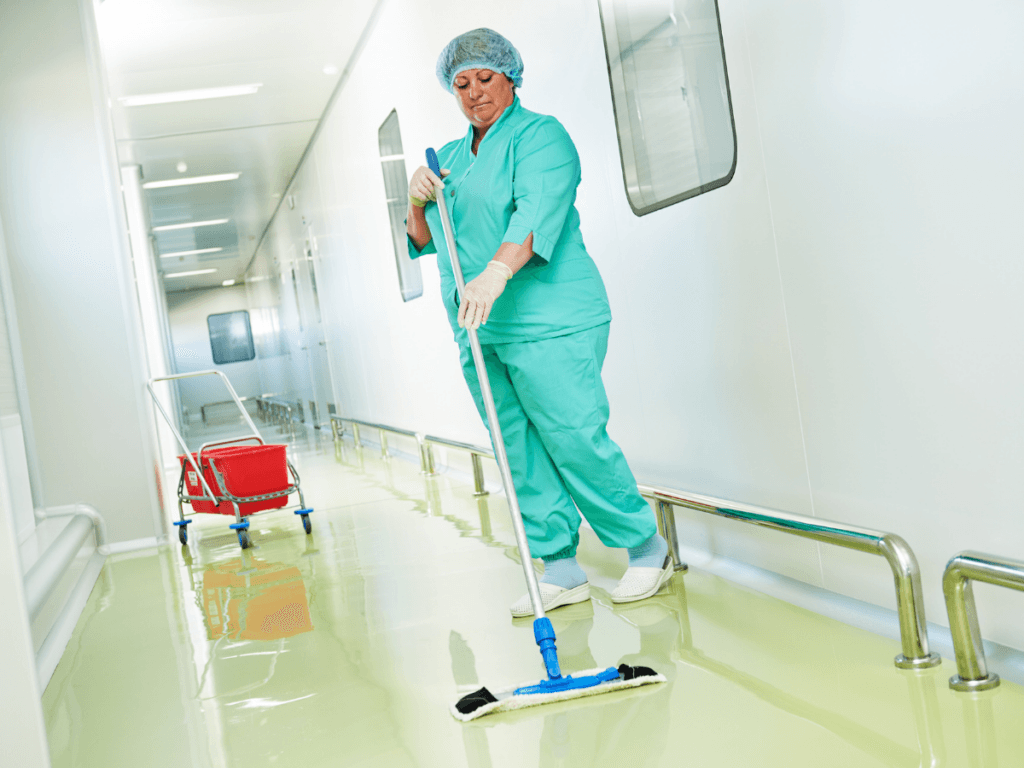
VCT can perform well for years in busy institutional settings, but its durability depends heavily on the maintenance program behind it.
Unlike flooring materials with a factory-applied wear layer that requires relatively little restorative care, traditional vinyl composition tile typically relies on a protective floor finish that must be cleaned, monitored, and periodically renewed.
For school flooring, that means maintenance planning should begin before the floor is installed. Custodial staffing, cleaning equipment, traffic levels, summer shutdowns, and the types of spaces being maintained can all affect the long-term cost and condition of VCT.
Healthcare facilities face similar considerations, along with more demanding cleaning schedules and room-specific sanitation protocols.
Remove Dirt Before It Damages the Finish
Tracked-in grit is one of the biggest sources of unnecessary floor wear.
Small particles can act like abrasives under shoes, carts, chairs, and cleaning equipment, gradually dulling the protective finish. High-traffic entrances and corridors usually need more frequent attention than offices or lightly used rooms.
Routine care should include sweeping, dust mopping, or vacuuming with equipment appropriate for hard flooring. Entrance matting can also reduce the amount of soil and moisture that reaches the VCT, provided mats are cleaned and maintained rather than allowed to become saturated or overloaded with debris.
For schools, entrance areas often deserve additional attention during rainy weather and periods of heavy student traffic.
Damp Mop With Compatible Cleaning Products
After loose dirt is removed, damp mopping or an appropriate automatic scrubber can address surface soil.
The specific cleaner, dilution ratio, equipment, pads, and procedures should follow the VCT and floor-finish manufacturers’ recommendations. A neutral cleaner is commonly used for routine care, but facility managers should verify product compatibility rather than assuming any general-purpose cleaner is suitable.
Using too much chemical can leave residue, while aggressive products may damage the finish or change the floor’s appearance.
Standing water should also be avoided. VCT itself is resilient, but excessive moisture can reach seams, edges, damaged areas, or the substrate below.
Clean Spills Promptly
Schools and healthcare facilities encounter everything from tracked-in rainwater to food, beverages, cleaning solutions, and other spills.
Prompt cleanup helps prevent staining and reduces the chance that contaminants will be spread through foot or rolling traffic. It is also an important safety measure because a wet or contaminated floor may have significantly different slip characteristics than a clean, dry surface.
In healthcare environments, spill response must also align with the facility’s cleaning and infection-control procedures. Maintenance staff should use the required disinfectants where appropriate while confirming that those products are compatible with the flooring and protective finish.
Maintain the Protective Floor Finish
Traditional VCT commonly uses layers of commercial floor finish to protect the tile from wear and create the desired appearance.
That finish gradually deteriorates under traffic and cleaning. Depending on the product and maintenance program, periodic procedures may include scrubbing, recoating, burnishing, or eventually removing deteriorated finish and applying a new system.
The appropriate schedule should be based on actual floor condition rather than an arbitrary calendar.
A heavily traveled school corridor may need restorative maintenance sooner than a classroom or administrative office. The same principle applies in hospitals, where entrances and main circulation routes may wear differently from low-traffic areas.
Over-maintaining the floor can waste labor and materials, while waiting too long can allow the protective finish to wear through and expose the tile itself to greater damage.
Inspect for Loose or Damaged Tiles
One advantage of VCT is that localized damage does not always require replacing an entire floor.
Facility staff should watch for:
- Cracked or chipped tiles
- Loose corners or edges
- Gaps that were not previously present
- Discoloration
- Uneven areas
- Repeated finish failure in the same location
- Moisture appearing around seams or edges
Replacing an isolated damaged tile early can prevent the surrounding area from deteriorating further.
Repeated failures deserve closer investigation. A tile that continually loosens may indicate an adhesive, substrate, moisture, or rolling-load problem rather than simple surface wear.
Protect Floors From Furniture and Rolling Equipment
Classroom desks, chairs, medical carts, beds, and other equipment create different stresses than ordinary foot traffic.
Furniture should have appropriate glides or protectors that are kept clean and replaced when worn. Dragging heavy objects across VCT can damage both the finish and tile surface, so equipment should be lifted or moved using methods appropriate for the load.
Healthcare facilities should also consider the repeated paths taken by heavy rolling equipment. Concentrated wear in those areas may justify more frequent inspections and finish maintenance.
Build Maintenance Around Traffic, Not Just Room Type
A practical maintenance program does not treat every part of the building identically.
For school flooring, a useful approach is to divide the facility into traffic zones. Entrances, cafeterias, main corridors, and common areas generally require more frequent cleaning and monitoring than classrooms, offices, or storage spaces.
Healthcare facilities can use the same principle while incorporating their own sanitation and operational requirements.
Daily soil removal, prompt spill response, compatible cleaning products, periodic finish restoration, and timely tile repair all contribute to VCT longevity.
More importantly, matching maintenance frequency to actual wear helps preserve the floor without spending unnecessary labor and materials on areas that do not need the same level of attention.
VCT is durable, but its service life is closely tied to how well the finish and underlying tile are cared for. A realistic maintenance plan is therefore part of the flooring decision itself, not something to figure out after installation.d safety of their VCT flooring.
What Does VCT Flooring Cost for Schools and Healthcare Facilities?

VCT is often considered a budget-conscious commercial flooring option, but material price alone does not determine what a school or healthcare facility will actually spend.
Subfloor preparation, removal of existing flooring, adhesive requirements, project phasing, floor finishing, labor, and long-term maintenance can all change the total cost substantially.
For school flooring projects, the more useful question is not simply, “What does VCT cost per square foot?” It is, “What will this flooring cost to install, maintain, repair, and eventually replace over the period the facility expects to use it?”
That lifecycle approach makes it easier to compare VCT fairly with other durable commercial flooring materials.
What Affects the Installed Cost of VCT?
Floor area matters, but it is only one part of the estimate. A large open corridor may be relatively straightforward to install, while classrooms with built-in fixtures, complicated transitions, numerous doorways, or extensive floor preparation can require considerably more labor.
Common cost drivers include:
- VCT product selection and pattern
- Condition of the existing substrate
- Moisture testing or remediation needs
- Removal and disposal of existing flooring
- Adhesive and preparation materials
- Furniture or equipment relocation
- Base and transition work
- Installation complexity
- Project phasing and restricted work hours
- Initial cleaning and floor-finish requirements
Schools may also need work completed during evenings, weekends, holidays, or summer shutdowns. Healthcare projects can require phased installation so that departments remain operational. Those scheduling constraints can affect labor and project duration even when the square footage is similar.
Subfloor Conditions Can Change the Budget Quickly
One of the hardest costs to estimate without inspecting the space is floor preparation.
VCT requires a sufficiently smooth and stable substrate. Old adhesive, cracks, uneven concrete, moisture problems, failed patches, or damaged existing flooring may need to be addressed before installation begins.
This is why two projects with identical floor areas can receive very different estimates.
A quote that includes only material and basic installation may appear inexpensive until preparation work begins. For institutional projects, the scope should identify what substrate preparation is included and how unforeseen conditions will be handled.
VCT, LVP, and Tile Have Different Cost Profiles
VCT is frequently chosen because its initial material cost can be economical, particularly across large commercial areas. That does not mean it is always the least expensive option over its entire service life.
LVP flooring typically has a different maintenance profile because many products do not require the traditional stripping and refinishing cycle associated with conventional VCT. Product quality, wear layer, installation method, and intended commercial use still need to be evaluated carefully.
Tile flooring may carry higher material and installation costs in many applications, particularly because substrate preparation and labor can be intensive. In return, properly specified tile can provide a long service life in spaces suited to hard-surface flooring.
A useful comparison looks beyond initial pricing:
| Cost Consideration | VCT | LVP | Tile |
|---|---|---|---|
| Initial material cost | Often relatively economical | Varies widely by product | Can be higher depending on material |
| Installation complexity | Moderate, highly dependent on substrate | Depends on product and installation method | Often labor-intensive |
| Finish maintenance | Common with traditional VCT | Usually no traditional finish system | Generally no finish system |
| Localized repair | Individual tiles can often be replaced | Individual planks may be replaceable | Individual tiles may be replaceable |
| Long-term cost driver | Cleaning and finish maintenance | Product quality and wear | Grout, breakage, and installation quality |
The best school flooring choice may differ from room to room rather than being determined solely by the lowest installation price.
Maintenance Labor Belongs in the ROI Calculation
VCT should not be sold on the assumption that it automatically reduces maintenance expenses.
Traditional VCT usually requires routine cleaning plus periodic floor-finish maintenance. Over a large school or medical facility, the labor and materials associated with scrubbing, recoating, burnishing, and eventual stripping can represent a meaningful operating expense.
That does not make VCT a poor investment. It means the return has to be evaluated realistically.
A facility with an established custodial program and equipment for maintaining VCT may find the flooring economical. Another organization with limited maintenance staffing may place greater value on a flooring system that requires less restorative care.
Repairability Can Improve Long-Term Value
VCT’s modular format can work in its favor when damage is localized. If a small group of tiles becomes damaged, individual pieces can often be replaced rather than removing a much larger section of flooring.
Keeping matching replacement material in storage can make future repairs simpler, particularly in schools where furniture, carts, equipment, and heavy daily use can create isolated areas of damage.
Repairability becomes part of lifecycle value because extending the usable life of an existing floor can delay a full replacement project.
Compare Complete Scopes, Not Just the Lowest Bid
For school flooring or healthcare projects, competing estimates should cover the same work before prices are compared.
Look for clarity about demolition, substrate preparation, moisture testing, materials, adhesives, transitions, base, floor finishing, furniture movement, cleanup, scheduling, and post-installation restrictions.
A low bid that excludes several of those items may ultimately cost more than a higher estimate with a complete scope. VCT can offer strong value in high-traffic institutional spaces, especially where its repairability and initial affordability align with the facility’s maintenance capabilities.
The best financial decision comes from comparing total installed and lifecycle costs rather than treating material price alone as the return on investment.
Conclusion
VCT flooring remains a practical choice for schools and healthcare facilities that need durable, cost-conscious surfaces capable of handling heavy daily foot traffic.
Installation costs can vary depending on the condition of the subfloor, project size, material selection, preparation requirements, and layout complexity, making professional planning important for achieving reliable results.
Proper installation and ongoing maintenance can help maximize the flooring’s service life while keeping high-traffic spaces functional and presentable.
For professional VCT flooring installation and commercial flooring solutions, choose Abel Pro Flooring. If you’re planning a flooring project for a school, healthcare facility, or other high-traffic property, call 404-566-0749 to speak with the team at Abel Pro Flooring or request your free quote today.